This morning, I pushed open a door that was stuck to its frame. When it sprung open, a hot splash of sunlight landed on my face. Or maybe, I was the one who had suddenly landed there, wobbling and stumbling into the path of the sun.
Somehow, the heavy clouds that had just washed the city in a grey rain were already blowing off in some new direction. So many different paths now seemed to sprawl before me, twisting and winding, narrow here, broad and airy there. Bright brass lamps beckoned to the right, and to the left, woven carpets draped the coarse coral walls of the short stacked buildings; all perfumed by the scents of cumin, orange blossoms, and fried fish. And now, my own thoughts also spill and spread in disparate directions.
I have begun and left unfinished Comma Directory entries about: eels and Camus, the persistence of New York City, victimhood in the writing of Paul Bowles and Jean d'Ormesson, food in Japanese film, the depiction of gangs in Latin American and Hong Kong cinema. Instead, I have let myself go deeper into the souks—buying nothing, jumping out of the way of motorbikes, looking at cats, thinking about the improbability of a new year and of Marrakech.
Burrowed amidst criss-crossing tram lines, flat broad boulevards, narrow cobblestone streets—there is a little café-shop that always brings me a sense of peace in Rabat. When I walk in, everything hushes, and then the sounds, smells and sights gently pick up again.
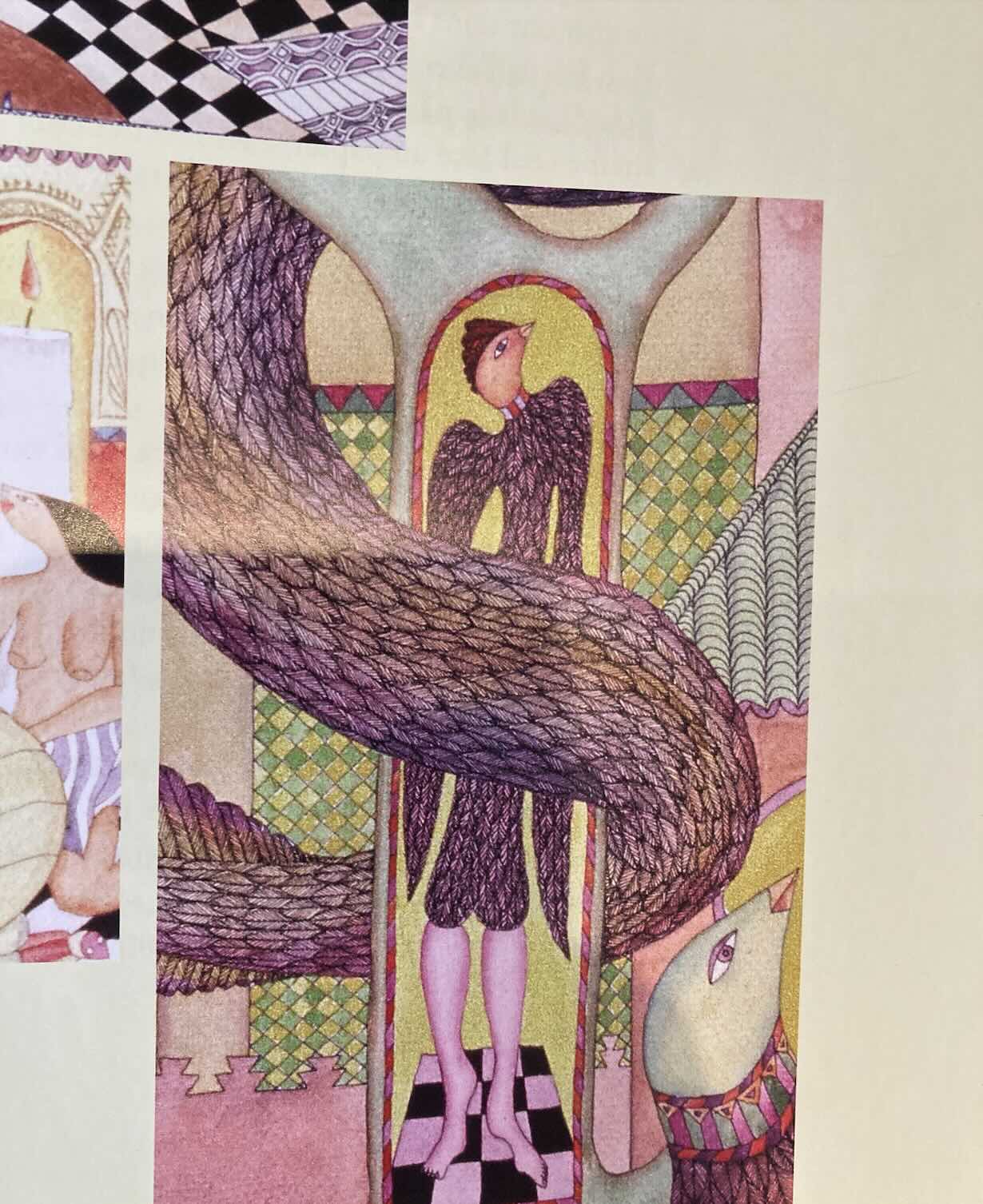
Wandering recently between the shop's teas, spreads, shawls and postcards, a book caught my eye. Without much thought, I flipped open the thick hardcover and encountered humanoid birds, exuberant vines, patterned tiles, palm fronds, and other leaves. I was immediately enchanted by the drawings, watercolors and paintings of Abbès Saladi.
Fig 1. A page from the book, Abbes Saladi: Histoires sans fin.
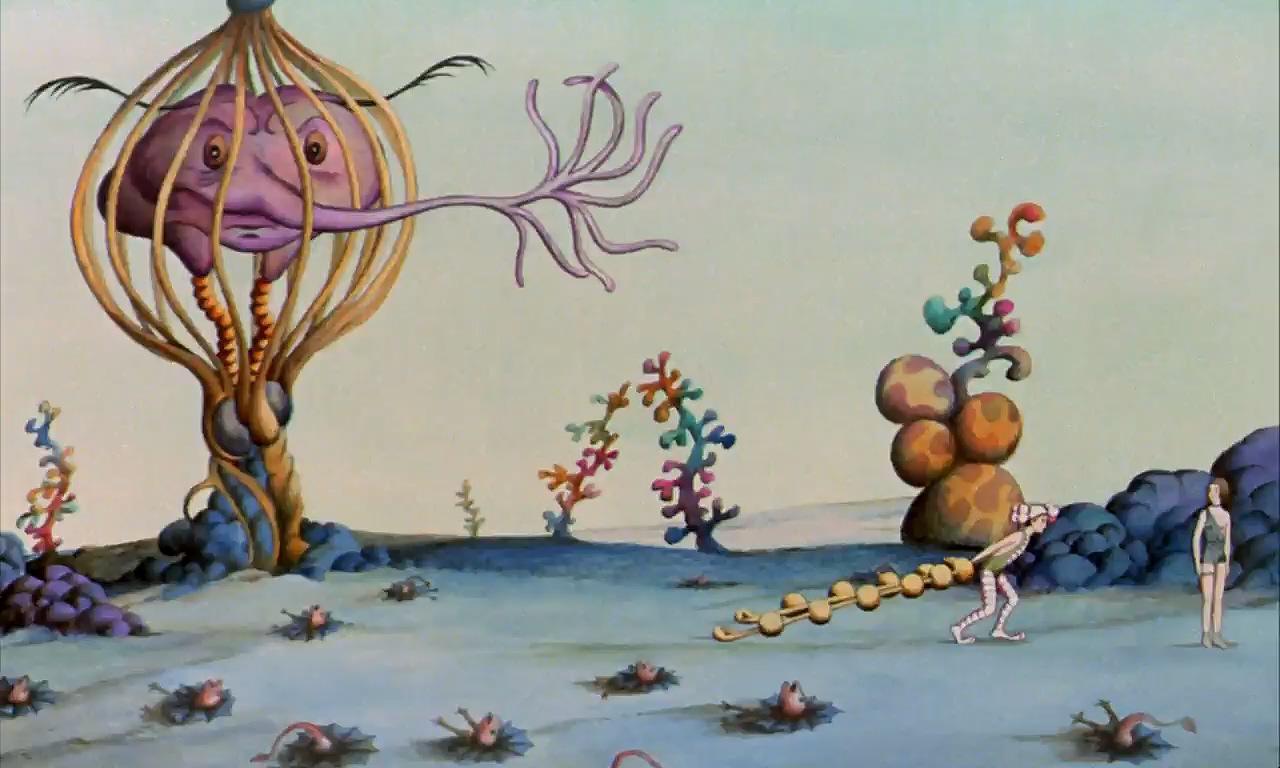
There is something about Saladi's work that makes me think of the film La planète sauvage. I could actually imagine an exhibition of Saladi's drawings set to the film's score composed by Alain Goraguer.
Fig 2. Scene from the animated sci-fi film, La planète sauvage.Source.
Browsing online, I discover that there is very little information available about the artist (perhaps there is more out there in Darija). Much of his work is in private collections and auction houses. I decide that I will gather a few facts from the book in the shop and create a Wikipedia article (one day, hopefully). In fact, if I had a library of my own, I would have bought the book about Saladi's art right then and there.
These sort of encounters remind me why I set out to travel in the first place. And there have been so many of them so far. It feels as if only moments ago I was admiring Gerard Sekoto's yellow houses in Cape Town and now I am admiring Saladi's sinuous bird people at the other end of the continent. These encounters have only multiplied as I have learned to seek them out. But perhaps what I need now more than anything is time to sit with all of these paintings, poems, essays, films, bits and pieces of art.
In Rabat, walls and rooms crumble into sea foam and towers rise on riverbanks. Cats always prowl just around the corner and in the shadowy depths of a worn and tattered grey building, I see a fire burning bright. Every morning, it spits out sweet cakes, hard breads, and cookies onto the sidewalk, to the delight of passer-by's. In Rabat, it rains plastic on the dirty blonde beaches and blue taxis race down perfectly palm-lined avenues. It has taken me a while to figure out how to write here. In the narrow, damp and dusty, streets of the medina, I am reminded of the smell of my great-grandmother's brick house in Bogotá. But once out among the merchants and the motorbikes, my ability to decipher what is before me recedes gently like the sea.